The Infamous Guild Neck Reset

Introduction

My 1976 Guild F-212 XL is in need of a neck reset. Guild guitars have taken on legendary reputation for being difficult to disassemble. Let's see if this one lives up to its name. This article is dedicated to the countless Guild acoustic guitar owners whose guitars have desperately needed a neck reset.

Neck Resets in General

For details regarding neck resets, what they are, how to determine if and when they are needed, etc., I encourage you to read my article » Neck Resets.

Rather than re-visit the contents of that rather lengthy article again, here, I am going to highlight what is going on with this 50-year-old Guild 12-string that informs me of the need for a neck reset.

What Is The Problem?

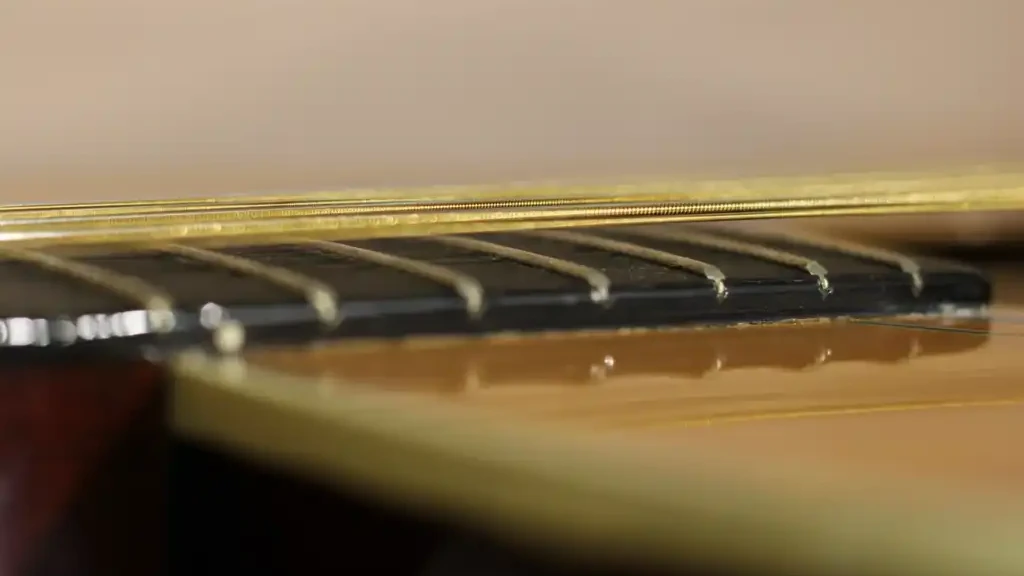
This guitar has become increasingly difficult to play, over time, as the action has raised. Fitted with light-gauge strings, and tuned to "Concert" (Standard, A=440 Hz) pitch, the 11th string is 5/32" (4.0 mm) away from the 12th fret.

Cozad Guitars - High Action

My target height for that string is nearly 1/2 its current height, at just barely over 5/64", or 2.0 mm.

That goal is a combination of staying with light-gauge strings and getting the action as low as possible without constant string-to-fret contact ("buzz") for my style of playing. To go lower, I could increase the string gauge (to mitigate buzz), but that comes at a price. The increased tension makes the guitar feel "harder" to play, as well as exacerbating the condition that caused the need for the neck reset in the first place. But I am getting ahead of my story.

A common approach to achieving a target action height is to adjust the saddle height. In this case, I would need to lower the saddle by sanding material off of its bottom, in order to preserve any radius and compensation filed into its top. How much material would I need to remove?

STOP! Before I go any farther, I need to make a few assessments.

Assessments

✅ - Fretboard Plane: My fretboard is a flat as I can make it using the twin compression rods. There is no forward bow in the neck, which would cause a false Action height measurement.

✅ - Bridge Lift: The back of the bridge on this 12-string remains securely glued down to the soundboard, with zero gap. Additionally, all internal bracing is securely fastened in place.

✅ - Bellying: While some bellying has occurred over time, it is by no means severe.

✅ - Saddle Height: The saddle projects 1/8" above the bridge.

❌ - Overall String Height: My target measurement is 1/2″. This guitar barely measures 23/64", falling a full 1/8" short.

✅ - Nut Slot Depth: The nut slots are cut and filed as low as they can go without introducing string buzz. The bottom of the nut slot is at the height of fret 0.

❌ - Action Height: My target height is slightly more than 5/64" from the top of the 12th fret to the bottom of the 11th string, the low E. I am WAY above that!

An Excellent Case Study

Five of my seven assessments to determine whether a neck reset is warranted, or not, passed. The two assessments that failed are such exceptional examples of failure that I am going to include them here, for posterity.

Failure #1 - Overall String Height: The height of the strings from the soundboard, as measured directly in front of the bridge, is both relative to the class of guitar being measured, and an indicator of performance potential.

This 12-string belongs to a class of steel string acoustic guitars that benefit from an overall string height of +/- 1/2". That roughly translates to a 3/8" tall bridge and a saddle that projects another 1/8" above the bridge. We have established that the saddle on this guitar is, indeed, projecting 1/8" above the bridge. However, the bridge is less than 1/4" tall. The overall string height on this guitar comes in below 3/8".

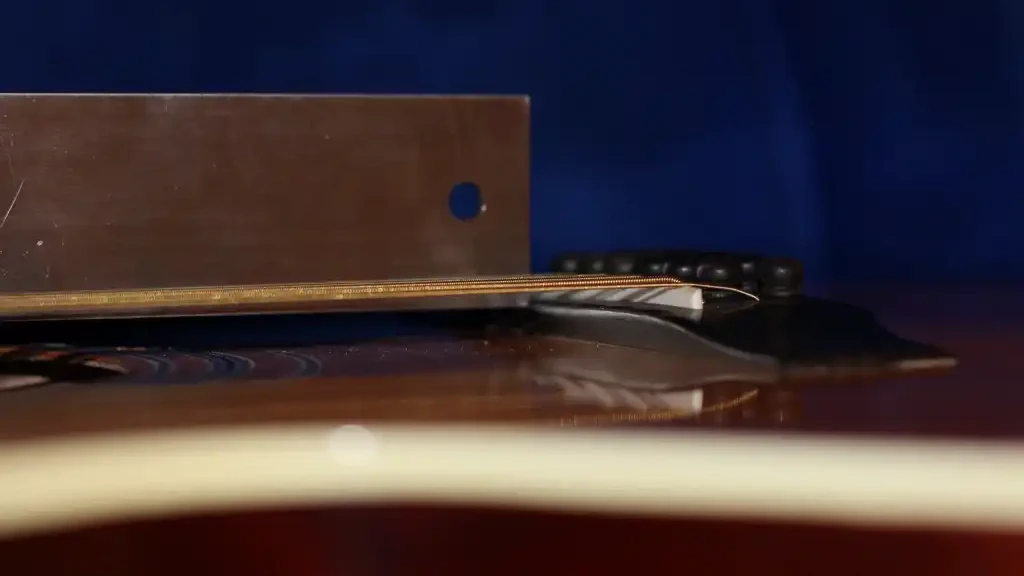
When pursuing the need for a neck reset, it is common to lay a straightedge across the fretboard and note where the plane of the frets sits in relation to the top of the bridge.
Cozad Guitars - Straightedge Test

This "straightedge test" seemingly passes! Coupled with the fact that, standing almost 1/8" above the bridge, it appears that there is "plenty of saddle" remaining, implying I can just whack material off the saddle to lower the action, it sounds like I'm good to go.

It is a good thing I know about my Overall String Height discrepancy, otherwise I could be seriously confused. We will set that issue on the shelf for the moment, because we have another failed assessment to discuss.

Failure #2 - Action Height: As you will see, this guitar's action is very high. As an isolated issue, big deal. We deal with high action all the time. What makes this guitar so interesting is that all the other assessments check out. Even the "straightedge test" with "plenty of saddle" remaining says everything is fine. I am going to show you why it isn't fine!

This guitar has become increasingly difficult to play, over time, as the action has raised. Fitted with light-gauge strings, and tuned to "Concert" (Standard, A=440 Hz) pitch, the 11th string is 5/32" (4.0 mm) away from the 12th fret.
Cozad Guitars - High Action

My target height for that string is nearly 1/2 its current height, at just barely over 5/64", or 2.0 mm.

That goal is a combination of staying with light-gauge strings and getting the action as low as possible without constant string-to-fret contact ("buzz") for my style of playing. To go lower, I could increase the string gauge (to mitigate buzz), but that comes at a price. The increased tension makes the guitar feel "harder" to play, as well as exacerbating the condition that caused the need for the neck reset in the first place. But I am getting ahead of my story.

A common approach to achieving a target action height is to adjust the saddle height. In this case, I would need to lower the saddle by sanding material off of its bottom, in order to preserve any radius and compensation filed into its top. How much material would I need to remove?

The 12th fret sits at a point approximately 1/2 way between the nut and the saddle. I can therefore understand the relationship between the string height at the 12th fret and the saddle height by using a multiplier of 2. For each unit of measure ("n") I consider modifying at the 12th fret, I double that unit of measure ("n x 2") to make modifications to the saddle.

I want to lower my action on the bass string at the 12th fret from 5/32" to 5/64" (or from 4.0 mm to 2.0 mm). My saddle currently projects a little less than 1/8" (3.0 mm) above the bridge.

Existing height at 12th fret: 5/32" (= 10/64")
Target height at 12th fret: 5/64"
Formula: (Existing height minus Target height) multiplied by 2
Saddle material to remove: (10/64" - 5/64") x 2 = 10/64" (reduced to) 5/32"

Existing height at 12th fret: 4.0 mm
Target height at 12th fret: 2.0 mm
Formula: (Existing height minus Target height) multiplied by 2
Saddle material to remove: (4.0 mm - 2.0 mm) x 2 = 4.0 mm

I have a big problem! I only have 3.1 mm (a little less than 1/8", or 8/64") of saddle projecting above the bridge, and that is measuring at its highest point. Attempting to reduce the saddle height by 4.0 mm (10/64") off of the bottom of that saddle will literally "bury" the saddle down into the slot!
One More Measurement

Moving forward, my mission is clear: I will be replacing the bridge with one that is sufficiently tall enough to satisfy my Overall String Height requirements. I will remove the frets and plane the fretboard dead flat. I will be resetting the neck to correct the geometry, such that my straightedge test is successful. But about that geometry stuff ...

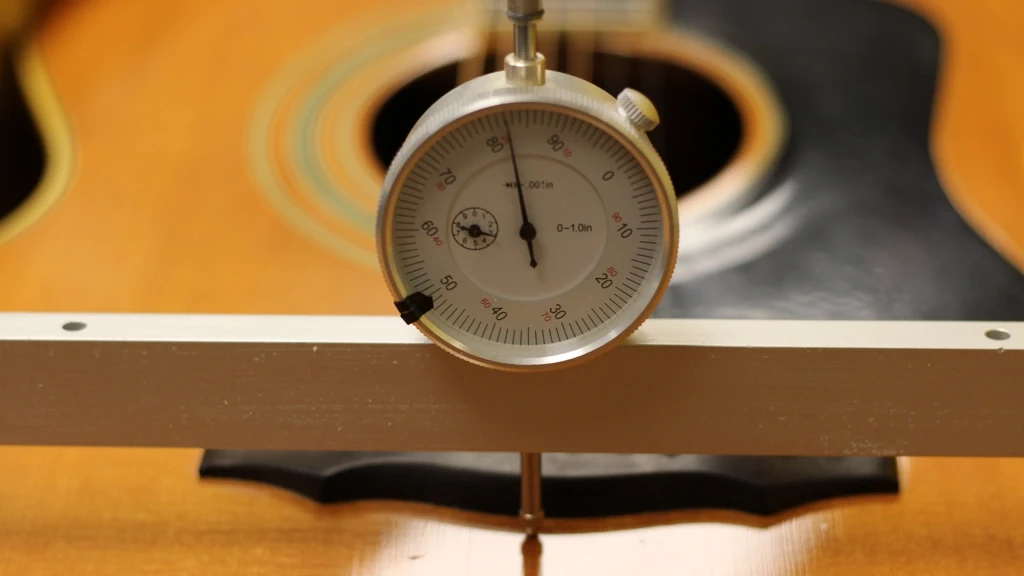
Before I remove anything, I want to measure top deflection. I need to know how much allowance to make for the bellying. The strings are pulling on the bridge, which is rotating forward, depressing the soundboard in front of the bridge, and lifting the soundboard behind the bridge. I will take two measurements at the top of the bridge, relative to the sides, using a dial indicator fitted to a gantry. The first measurement will be taken with the strings tuned to pitch. The second measurement, taken in precisely the same position, will be taken after the strings are loosened. The difference between the two measurements becomes my allowance.

Cozad Guitars - Top Deflection Measurement

Why not calculate my neck reset geometry prior to loosening the strings? Because I will be re-fitting my neck without those strings attached, and it is too easy to miss my target angle when I am just hoping and guessing.

Are Guild Neck Resets Harder?

Guild acoustic guitars, particularly older models, are somewhat legendary among repair shops, the consensus being that neck resets are more difficult to perform on a Guild than on other guitars. The Guild brand is among those who did not switch to bolt-on mortise and tenon necks, choosing to retain the more traditional glued-on compound dovetail joint. To reset a neck, it is first necessary to remove it. Guild necks were first attached to the body, and then the finish was applied. This complicates the removal process and adds the need for touch-up efforts once the neck is re-applied.

Cozad Guitars - Vintage Guild Neck Joint

The Finish - To remove the neck, the lacquer “seal” must first be broken. After the neck is reset, that lacquer must then be touched up. This can be complicated by a tinted finish, though it isn't a particular nightmare in and of itself. If, by extreme contrast, you have ever reset a Taylor neck (bolt-on, no lacquer touch-up necessary), you would understand the extra work involved on a Guild neck, along with the additional equipment and skills requirement.

The Glue - If you have reset enough Martin necks you may have run across that occasional instrument where it seems as though you could simply pull the neck off after exhaling a warm sigh across the heel. If you were to then encounter any one of the several Guild necks where any and all open space in the neck joint has been thoroughly flooded with 250 to 300 gram strength hide glue, you would likely conclude that Guild neck resets can be more difficult to remove.

Some Guild necks are more difficult to remove than others, although few, if any of the ones I have encountered from the 1970s and up through 2010 have ever been as easy to remove as the bulk of Martin necks I have removed from the same period. Unfortunately, I cannot provide anyone with an authoritative list of which Guild guitars are more difficult than others, as it remains a mystery even to me until after I have started on a removal.

At issue is the amount of glue applied in the neck joint, and the surfaces to which the glue has been applied. All that should be required of a properly fitted compound dovetail joint is a brush (or fingertip) stroke of glue along the two sides of the tail. The purpose of the adhesive is merely to prevent the tenon from sliding upward in the mortise, the reverse direction from which it was “set.” The one and only possible reason I can think of for applying copious amounts of glue to a dovetail joint, other than ignorance (not knowing any better), is to compensate for a sloppy fit. So, rather than take the time necessary to correct the actual problem, the loose fit, someone just adds more glue to hold the neck in place.

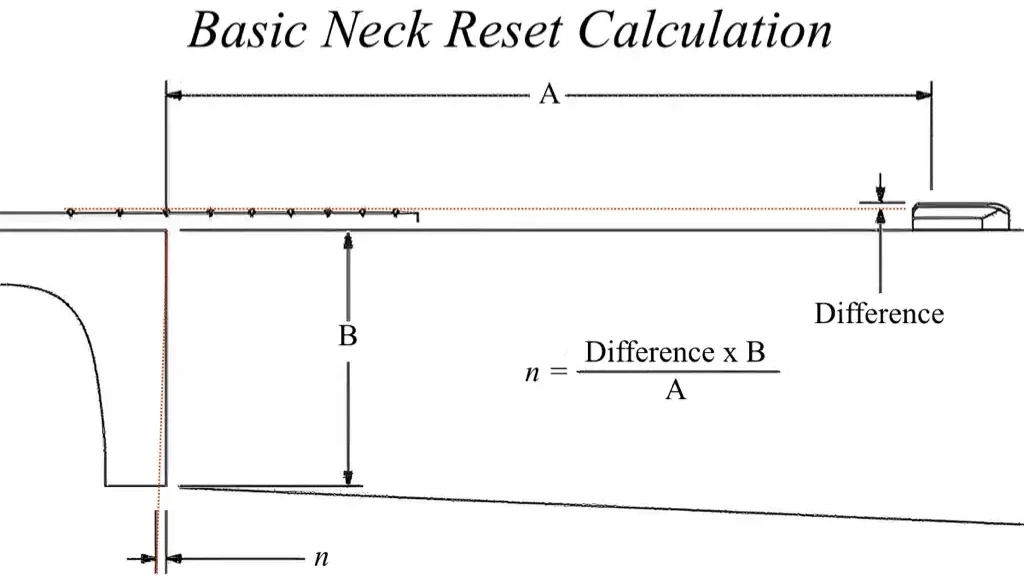
Cozad Guitars - Neck Reset Calculation

REMINDER: When I am resetting a neck, to determine how to address the neck heel I ignore the existing bridge and make my calculations against my target overall string height. If I can achieve that height using the existing bridge (and typically fashioning a new, taller saddle), great. If not, I make a new bridge.

While this approach is not dissimilar to setting a neck on a brand new guitar, there are additional factors to consider when resetting a neck on an already built guitar, factors that will affect the measurements used to determine how much material to remove from the neck heel. These factors include bellying behind the bridge, sinking in front of the bridge, and shift/collapse at the neck block.

It is advisable to take measurements with the guitar strung to pitch and compare those results with measurements taken after the strings are removed.

For the soundboard measurements, you can use a dial indicator that references the rims. You can also lay a straightedge across the top and note the deviation from a flat plane.

Article is being updated ...

Please check back, as this article is currently being updated.

Remove the Neck

Break the lacquer seal. Remove the 13th fret. Drill the hole(s). Apply the Heat Stick.

Neck Geometry / Correction

Dovetail joints and compound angles

Bridge Replacement

Materials, Optimal size

Neck Fitting / Re-attachment

Proper fitting and alignment, glue choices, clamping

Address the Finish

Touch-up, drop fill, re-finish